Avenues Policy Overview
Note: All links to maps and relevant documents can be found at the end of the document.
1. Toronto’s Official Plan
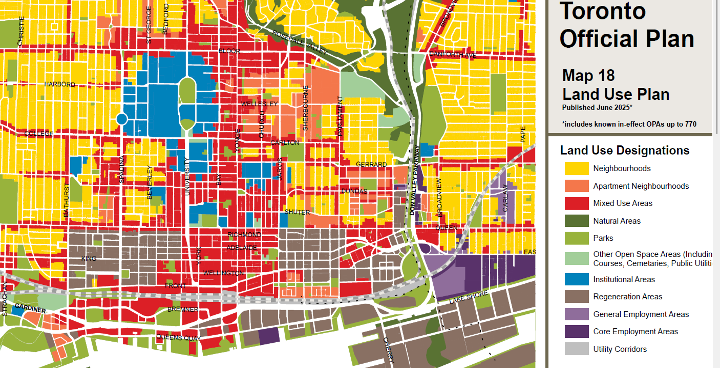
Toronto divides land use into categories
· Neighbourhoods: [VJ1] Low-rise residential only e.g. Havelock, Dovercourt, Ossington north of Dundas, and part of Dufferin Street.
Apartment Neighbourhoods: High-density residential, including mid-rise e.g. Jameson
Mixed Use Areas: Commercial (shops, restaurants, hotels) + housing; typically mid-rise main streets e.g. College
2. What Are “Avenues”?
Avenues are major streets the city identifies as growth corridors—places intended for mid-rise buildings (6–14 storeys) close to transit.
3. Avenues Phase One (Feb 2025)
City Council adopted Official Plan Amendment 778, adding 283 km of new Avenues (now 455 km total). This was the “vision.” See Map 2 below from OPA 778. The roads in purple and pink were approved in Feb[VJ2]
The issue: Many Avenues are still designated “Neighbourhoods,” meaning mid-rise isn’t allowed unless a developer goes through years of rezoning and appeals.
To fix this, the City launched the Avenues Policy Review to redesignate these streets so mid-rise becomes as-of-right (no rezoning required). This essentially “pre-approves” them.[VJ3]
4. Phase Two: Schools Come [VJ4] Into Play (Dec 2025)
The purpose of phase two is to identify which Avenues will be redesignated to Apartment Neighbourhoods or Mixed Use Areas—which legally permits mid-rise. It's staged by ward, prioritizing transit-heavy areas:
• Stage One: Pilot in Ward 11 (University-Rosedale) and Ward 9 (Davenport).
• Stage Two: Remaining Toronto & East York wards (Q2 2026).
• Stage Three: All other wards (2027+)
On December 3, 2025, the Planning & Housing Committee (PHC) adopted the [VJ5] Stage One (Item PH26.4). It goes to City Council Dec. 16–18.
The pilot maps include the following public-school sites for redesignation to Apartment Neighbourhoods; the land use category intended for mid-rise buildings:
Examples in Ward 9:
· Dewson Jr. PS
· Old Orchard Jr. PS
City Planning confirms in their Staff report (pg. 14 of ) that school properties are included.
NOTE: Catholic schools were excluded due to an ongoing appeal, but the Toronto Catholic District School Board made a submission to PHC requesting inclusion "for consistency."
Why does Planning say they’re doing this?
On page 1 of the Planning Staff report states:
“Phase Two of the Avenues Policy Review now moves from policy to implementation. It studies new and previously unexamined Avenues to determine where redesignation to Mixed Use Areas or Apartment Neighbourhoods—with corresponding zoning—is appropriate to enable mid-rise development."
In an email, Planning told the Beaconsfield Village Residents Association:
“Redesignation aligns the land use framework with long-term planning and creates consistency across different levels of policy.”
That “consistency” is exactly what now makes school lands easier to sell or redevelop.
5. How School Properties Can Be Sold – Even Just Pieces
Under Ontario Regulation 374/23 (in force Dec. 31, 2023):
A board can declare any part of a school site (e.g., parking lot, playground, field) surplus if it’s not needed for accommodation within 10 years.
The main school can stay open while the surplus portion is severed and sold or leased.
The law explicitly applies to “a school site, part of a school site, or other property.”
This is key:
Toronto can redesignate a site for mid-rise → and the school board can then sell off the part that now matches that zoning.
6. Why Bill 33 Makes the Risk Worse
What Bill 33 actually does:
Bill 33 (Nov 20, 2025) amends the Education Act (ss. 230–230.7) to give the Minister:
Broad investigative authority into any “matter of public interest” (which includes finances, governance, asset management).
Power to issue binding directions that a board must follow.
A new vesting power (no longer requiring Lieutenant Governor approval) allowing the Minister to assume control of a board’s administration—including its property decisions—if the board fails to comply or is otherwise not meeting expectations.
Why this matters in Toronto right now:
The TDSB has been under supervision since June 27, 2025, when Minister Calandra appointed Rohit Gupta as supervisor due to projected deficits.
Under supervision:
Trustees cannot make final decisions.
The supervisor acts in place of the Board.
The Minister can override the supervisor at any time.
Bill 33 strengthens this regime by giving the Minister quicker, simpler pathways to:
direct a board to sell land,
approve a sale a board cannot afford to refuse,
override local priorities (e.g., parkland needs),
and bypass public-sector “first-offer” requirements if a vesting order is issued.
The combined effect:
The City redesignates a school site for mid-rise.
The board (or supervisor/Minister) can now declare part of it surplus (still needs to show that school or school lands (playgrounds/parking lot are not needed for 10 years).
Bill 33 lets the Minister rapidly compel or approve the sale.
The usual local safeguards (trustee votes, municipal first rights) weaken or disappear.
For example, TDSB proposed declaring 2327 Dufferin St. (a leased site to Lycée Français de Toronto, who wants to purchase it for continued school use) surplus in a June 9, 2025 public meeting; under supervision, final decisions rest with the province, not trustees.
This is the first time Toronto has aligned school sites with mid-rise zoning at the same moment the province has expanded its override powers.
7. Why This Matters (Even Without Bill 33)
Whether or not the province intervenes, the redesignation signals that these sites are “appropriate” for mid-rise, which can influence:
internal board asset reviews,
surplus decisions,
long-term redevelopment strategies.
Major concerns include:
1. Loss of green space
· Schoolyards play a critical role in dense neighbourhoods with limited parkland. Toronto already has only 9.5 hectares of parkland per 1,000 residents—well below global benchmarks.
2. Equity impacts:
· School grounds are free outdoor space, especially important for families without private yards and for community programs.
3. Boards see redevelopment potential:
· The Toronto Catholic board’s submission requesting inclusion in the redesignation maps suggests boards themselves view mid-rise zoning as a future redevelopment opportunity—not just “policy consistency.”
4. Planning mismatch and timing problem:
· Redesignating school land for mid-rise makes it easier to sell, because it signals the site is suitable for redevelopment.
· Boards base decisions on current facts—today’s enrolment and confirmed developments—since mid-rise projects take years and many never materialize.
· Under O. Reg. 374/23, a board may declare land “not needed” if it doesn’t expect to require it within 10 years, a judgment made with limited information.
· The result: land can be sold off long before new housing — and new students — arrive. Once open space is gone, it can’t be rebuilt when enrollment eventually rises.
· Redesignating active school lands creates a premature, one-way path to land loss and should be excluded from mid rise development.
8. Conclusion
For the first time, Toronto is formally redesignating active school sites for mid-rise development through the Avenues Pilot. At the same time, Bill 33 gives the province dramatically expanded authority to force or approve school-site dispositions.
Together, these create a clear pathway—even if unintended—for the loss of:
school playgrounds
grassy areas
ravines
paths connecting communities[VJ6]
sports fields
and other parts of active school properties
…in neighbourhoods that actually need more school green space as density grows.
This is unfolding right now, largely unseen, and sits squarely at the intersection of planning, provincial education policy, land management, and neighbourhood equity.
Here are all the relevant links
Description
Link
City of Toronto Avenues Policy Review Website
Land Use Map 18
https://www.toronto.ca/wp-content/uploads/2017/11/97fe-cp-official-plan-Map-18_LandUse_AODA.pdf
Full set of city-wide land use maps (13-23)
Avenues Map 2 from OPA 778
All material posted to the Planning and Housing Committee PH26.4
Agenda Item History - 2025.PH26.4
The following are key documents are listed under PH26.4
Staff Report: Housing Action Plan: Avenues Policy Review Phase Two: Initial Study Ward 9 and 11
https://www.toronto.ca/legdocs/mmis/2025/ph/bgrd/backgroundfile-260227.pdf
Official Plan Amendments (OPA) 861 and 862.
These are the maps that show you what lands are being proposed for redesignation in Wards 9 & 11
· OPA 861 covers lands inside Major Transit Station Areas (near big subway stops, for denser builds);
o OPA 861 – Attachment 5
· OPA 862 covers lands outside them (slightly lower scale)
o OPA 862 – Attachment 6
PHC Video
See the discussion on PH26.4 starting at 5:25:17 (deputations include community concerns).
https://www.youtube.com/watch?v=fA-9nzN9GvU&t=18717s
Beaconsfield Village Residents Association Submission
Our letter to PHC raising alarms on schools and other concern; (filed under communications).
https://www.toronto.ca/legdocs/mmis/2025/ph/comm/communicationfile-200641.pdf
Toronto Catholic School Board Submission – see content under heading TCDSB Concerns – also lists the properties it would like to have redesignated (filled under communication)
https://www.toronto.ca/legdocs/mmis/2025/ph/comm/communicationfile-199359.pdf
Email Reponse from Planning on Question about Redesignating Schools and our[VJ7] response
Planning:
Thank you for sharing your concerns. I appreciate the chance to clarify why school sites are included in the proposed redesignations.
Schools are permitted in Neighbourhoods, Apartment Neighbourhoods and Mixed Use Areas and are not exclusively designated as Neighbourhoods in the Official Plan. Redesignation does not mean redevelopment is imminent or approved, or signal that it should be a redevelopment site. The redesignation aligns the land use framework with long-term planning and creates consistency across the different levels of policy.
Our response:
This frames redesignation as a harmless “policy alignment,” but in practice it changes the planning assumption for the site. Once a school property is redesignated to a category where mid-rise buildings are considered appropriate, that becomes the baseline against which any future redevelopment application will be evaluated. It also affects how the School Board interprets long-term need for the site under provincial rules.
Planning:
The City recognizes the importance of schools including yards and play areas. The redesignation does not override these protections or authorize carving off portions of school sites. Should there be any future proposal it would still require a planning application including public consultation and review under Official Plan policies for school sites, compatibility, and transition. The TLC/TDSB have confirmed that do not have any plans to redevelop or dispose of portions or the entireties of these school sites.
My understanding is that surplus school sites will still be offered first to other school boards and to municipal, provincial, and federal agencies before they go to the private market. I’m copying Yvonne Choi, Director of Planning for TLC/ TDSB who can help provide more info.
Our response:
These protections only apply if the land is still a school site.
If a Board later decides that part of the land is surplus, those protections no longer apply—the land is no longer treated as a school.
It would be the same consultation you’d get for any mid-rise proposal: one community meeting, circulation, comments, and a staff report.
Planning’s wording implies an extra safeguard, but it's the routine process used for every private development.
Once declared surplus, the disposal path is not as protective as Planning implies. Traditionally, the land would first be offered to other public bodies—but Bill 33 gives the Minister the power to exempt specific disposals from that requirement, meaning a site could go directly to the private market.
In other words, redesignation doesn’t force redevelopment, but it creates the conditions where selling part of a school property becomes easier before the population growth that supposedly justified the redesignation ever appears.
[VJ1]I took off the colours because they're obvious in the map below and I felt it added more unnecessary words
[VJ2]in Feb 2025?
[VJ3]Do you feel comfortable saying this? Tina Yazdani used this phrase in her CityNews segment and I think it's helpful and clear, even if it's not 100% pre-approved.
[VJ4]I took out "Pilot" for clarity in the title, just to simplify it.
Also I think we should use "stage 1" instead of pilot whenever possible because we know it's not really a pilot
[VJ5]just confirming you mean "the" to be there
[VJ6]my suggestions (for instance all those things would be lost if OOOPS were developed) but feel free to delete. Just want to communicate that it's something more than just sports fields and playgrounds.
[VJ7]Just because people won't know who "my" refers to